Emergency Fund Strategy: How To Position

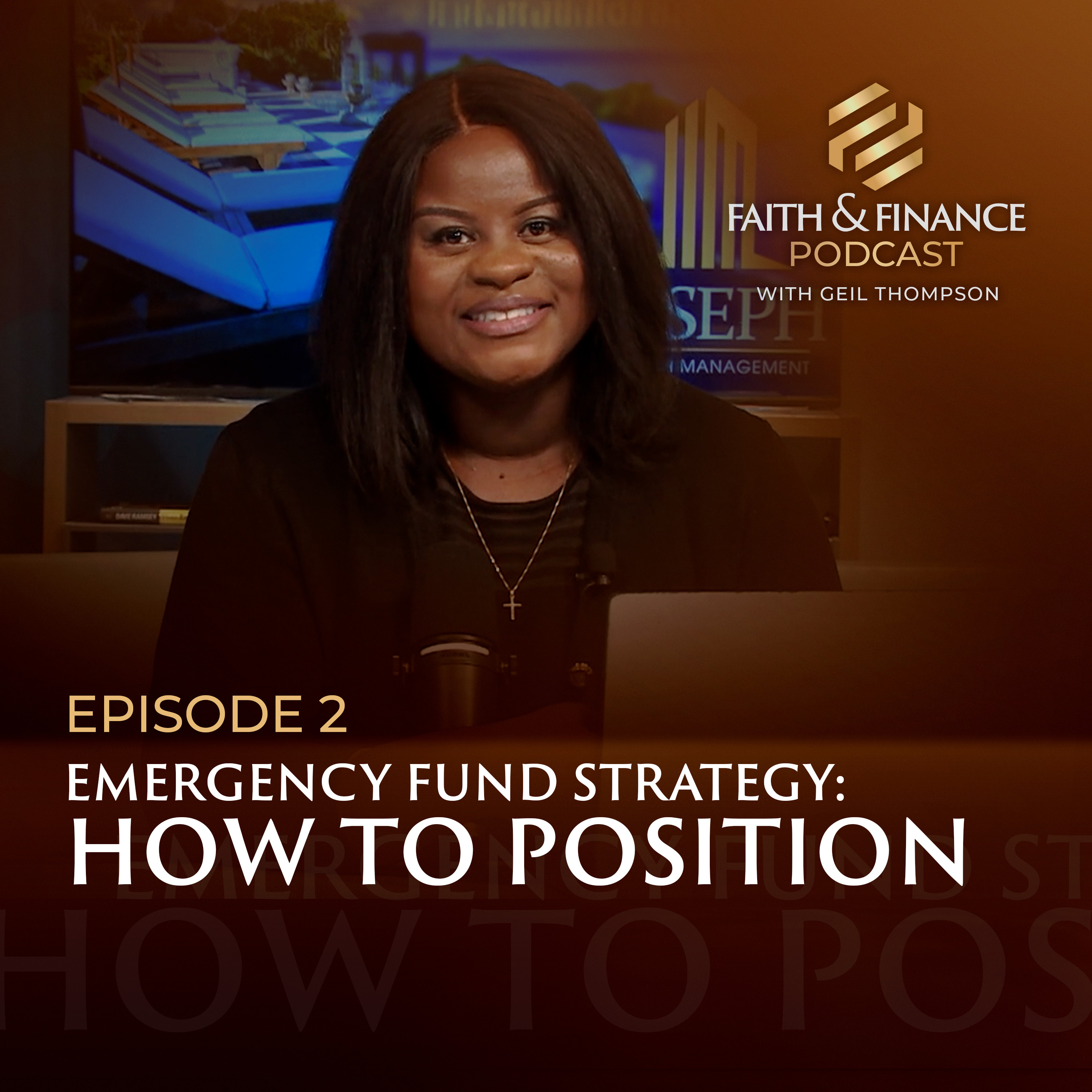


Ask yourself: Are you just saving cash — or are you positioning capital?
Most people ‘save’ cash—Geil teaches how to ‘position’ it. Learn how to protect liquidity while still earning, and understand how the wealthy treat cash as working capital.
Take control of your emergency fund strategy. Visit JosephWealthManagement.com or call 800-807-2881.
Follow us on Social Media:
https://www.facebook.com/josephwealthmgt/
https://www.instagram.com/josephwealthmgt/
https://www.youtube.com/@JosephWealthMgt
https://www.linkedin.com/company/joseph-wealth-management/about/
0:01 Hey there, and welcome to Faith in Finance, where your values and your financial vision come together. I'm your host, Geil Thompson, Register Rep for Joseph Eden Capital, a sister firm of Joseph Wealth Management. Every week, I'll be walking with you through the tools, truths, and strategies that help you build wealth with purpose, clarity, and peace. Because your money isn't just about what you have, it's about what you're building. Let's get started. Each week, we'll break down how capital moves, how markets shift, and how you can position your resources with wisdom and strategy to build ownership, grow wealth, and establish lasting legacy. Today, we're going to talk about something almost every person thinks they truly understand, cash. Yeah, you heard me right, cash. Most people were taught that if you want safety, you sit on cash. You save money in a checking account, maybe in a savings account, maybe a CD. But here's the uncomfortable
1:31 truth. Cash sitting idle is not wealth, nor is it wealth building. It's actually unproductive capital. In fact, in today's global economy, sitting cash or cash sitting idle is shrinking every year. Because of one force that we oftentimes forget and I teach my clients about this all the time that word inflation Never forget it Inflation quietly reduces or I'll say erode your purchasing power the dollar you save today buys less tomorrow because of inflation if Your emergency fund is only sitting in a basic savings account earning less than 1 % but inflation is running at three and four percent or even higher, you're losing value every single day. And this is where the wealthy think differently. The wealthy don't simply save cash, they actually position it.
2:32 They ask, is if my capital is sitting, how can I make sure it's still working safely for me? See, cash has a purpose. They use it for what we call liquidity. You want it available for emergencies, for flexibility, for unexpected opportunities, and even opportunities to invest. But having liquidity doesn't mean you surrender growth. It still has to make money while you're sleeping. Remember, we talked about this. We live in a globalized economy. And what do I mean by that? Well, What happens is, is that whatever happens in one corner of the world, it can directly impact interest rates, currency values, commodity prices, and even your savings account instantly.
3:23 Wars, pandemics, trade agreements, banking crises, and even the tariffs, right? All of it affects how capital moves. The reason most people get caught flat -footed is because they don't understand even so -called safe money, okay? The wealthy position cash in vehicles that acknowledge this reality. At Joseph Wealth Management, one of the tools we use and what we call is the Joseph Storehouse Treasury Program. It's built on a simple but powerful principle. If my cash needs to sit, let it sit inside something that's working for me. And what do we use? We use treasuries.
4:08 U .S. government -backed bonds that offer the safety of a guaranteed repayment so you get your money and your principal back, but you also get a yield that far exceeds traditional savings accounts and what banks are giving out in checking accounts. Right now, you can get a treasury that's paying anywhere between four to five percent, depending on the economic environment. And remember, these prices don't always stay the same, so it's best to contact an advisor so that you can lock in the best rate. But when you compare this to your local bank savings account, where you're earning less than 1 % for the same liquidity, but you can get a higher yield with a fully -backed U .S. government bond, listen, I would say the choice is simple. Don't necessarily leave your money sitting in a savings account or checking account where it's not benefiting you. We've already discussed what happens. The bank will lend your money out. They'll make money on it, but then they'll still only come back and pay you the 0 .5 or 1%. But this, what we're talking about is called position liquidity. It's not risk -free. but it's significantly safer than many other options and it acknowledges that cash should still serve a role in your wealth building process. See listen, most people confuse feeling safe with being strategic. Having cash in a savings account feels safe because it's familiar, and
5:40 I get it, I was there. But ask yourself, what's actually happening with my cash while it's sitting there? What are banks doing with my money? So this is what I want to do. I want to break this down for a moment so that you can really understand the deposit process. So the moment you deposit your money into the bank, it doesn't just sit there. The bank immediately puts the money to work before themselves, not for you. A bank will loan your deposits out as mortgages, business loans, credit card lending, and other interest generating activities. They lend it at higher rates and pay you back a fraction from what they make off your money. So example, if you deposited $10 ,000 today, the bank might lend out 9 ,000 of it, of which they'll go ahead and use that $9 ,000 and generate probably six to 8 % in interest.
6:40 Meanwhile, they'll pay you back less than 1%, interest to hold your money. The bank makes money by using your money to generate returns. In short, you're the one doing the saving and they're the one doing all the multiply. That's why wealth builders say you be the bank. Don't just fund the bank. Now let's take that same example but this time you're not going to give the bank control. You're going to position your money intentionally. So, you take the same $10 ,000 that you set aside for safety and liquidity. Instead of letting the bank loan it out and pay you only less than 1%, you place it in something like a storehouse vehicle, or in this instance, the Joseph Storehouse Treasury program that we offer. Your money is now invested into these U .S. Treasuries. Guess what? They're fully backed by the full faith and credit of the U .S. government. Your principal is secure and safe. Your funds remain liquid and accessible for when you need them, but instead of earning less than 1%, you now have the opportunity to generate 4 to 5%, depending on current rates.
7:55 In other words, you're protecting your cash. You're still fully liquid for emergencies, but you're no longer funding the bank's profits. You're keeping the yields for yourself. That's the power of position liquidity, where your cash still serves its protective purpose, but also works intelligently on your behalf. This is how capital allocators think. So here's a simple way to think about your financial positioning. You want liquidity, but you want position liquidity. You want safety, but you don't want stagnation. You want access, but without surrendering the grow. This is the discipline, the wealthy practice with every dollar they manage. They never park their money. They position it. Your emergency fund is not separate from your wealth strategy.
8:50 Let me teach you something. It's actually the foundation. If you mismanage this layer, you start every wealth building plan on unstable ground. When you structure your emergency fund correctly, Fully liquid, fully earning, fully secure, you create confidence to take larger, smarter wealth building moves later. Now the question is simple. Are you just saving cash or are you positioning capital? And if you're ready to take your emergency fund strategy to a level that aligns with how serious wealth is built, I invite you to connect with us directly at josephwealthmanagement .com. Listen, schedule a private consultation. Whether you're starting fresh or restructuring your full capital strategy, every dollar needs a job and every dollar deserves purpose. Let's build your strategy together and we look forward to hearing from you soon. Before we wrap up today, I want to offer you something from a faith perspective that speaks directly to the importance of how we position our resources.
10:05 In the book of Genesis, Pharaoh had a dream, seven years of abundance followed by seven years of famine. Joseph, guided by God, interprets the dream and then does something crucial. He builds a financial strategy. Joseph doesn't just prepare Egypt emotionally. He prepares them practically. He creates a system called the storehouse system, setting aside portions of their money during the years of plenty, not just to save it, but to position it for the years to come. They stored grain, they stored corn, and it wasn't just sitting, it was ready, it was protected, and it was purpose.
10:48 And when famine hit, Egypt wasn't panicking. Egypt was prepared, not because of fear. but because of foresight. That's the posture we're called to carry. An emergency fund isn't fear -based. It's faith -based wisdom, being a good steward just like Joseph, positioning our resources with strategy so we're not reactive when the unexpected comes. Because God doesn't just call us to survive the famine. He equips us to lead through it. Because what we know is when there's famine, there's also opportunity. So whether you're in a season of plenty or preparation, remember, storehouses aren't just a place to hold money. They're places to multiply wisdom.
11:59 The Faith and Finance podcast is intended for educational, informational, and entertainment purposes only. The views and opinions expressed by the host and guests are their own and do not necessarily reflect those of Joseph Wells Management, Joseph Eden Capital, or any affiliated entities. Nothing shared on this podcast should be construed as personalized, financial, legal, tax, or investment advice. All investing carries risk, including the potential loss of principle. Listeners are strongly encouraged to consult with a licensed financial advisor or fiduciary who understands their unique circumstances before making any financial decisions. Joseph Wealth Management and Joseph Eden Capital are registered entities and operate in accordance with applicable regulatory guidelines. Business is conducted only in jurisdictions where they are duly licensed or exempt from registration.