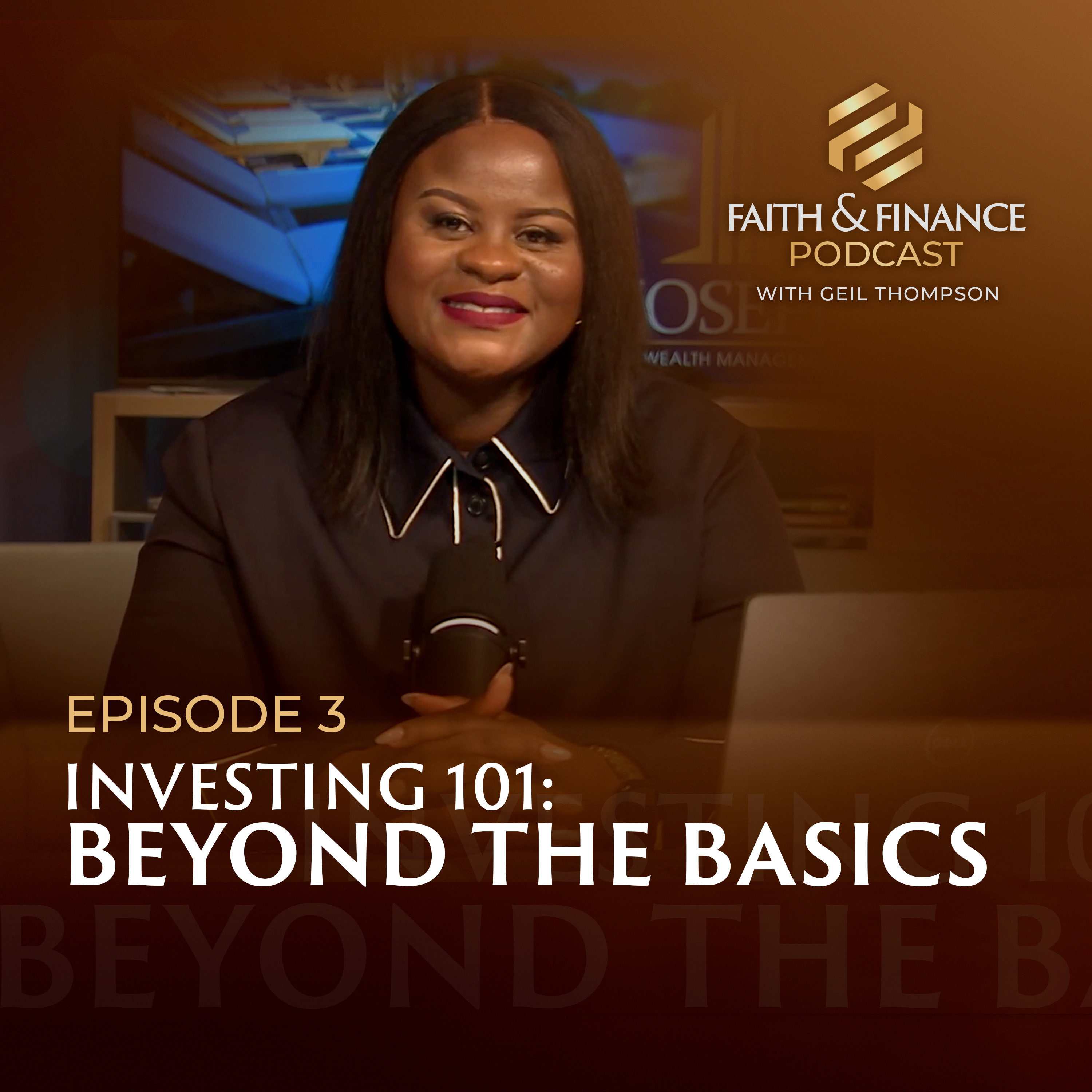
Investing 101: Beyond The Basics



Open your first investment account or increase your contribution by $50 this week.
Geil breaks down the foundations of stocks, bonds, mutual funds, and index funds. This episode helps listeners start their investment journey with clarity and confidence.
Need help getting started? Schedule a call at JosephWealthManagement.com.
0:01 Hey there, and welcome to Faith in Finance, where your values and your financial vision come together. I'm your host, Geil Thompson, Registered Rep for Joseph Eden Capital, a sister firm of Joseph Wealth Management. Every week, I'll be walking with you through the tools, truths, and strategies that help you build wealth with purpose, clarity, and peace. Because your money isn't just about what you have. It's about what you're building. Let's get started. baby Today, we're getting into one of the most powerful tools for building wealth, and that's investing. Now, I know for many people, investing can feel intimidating, confusing, or like something other people do.
1:11 Or you might say, not you. But I'm here to tell you that investing isn't just for the wealthy or for experts or even Ivy League grads. It is for you, and it's for you right now, no matter where you're starting, And today I'm going to show you exactly how. So listen, here's the truth. If you want to retire with dignity, grow generational wealth, or simply make sure your money is keeping up with inflation, you have to invest. Savings alone will not get you there. And you may ask me why. Because here's the thing. Inflation eats away at the value of your money every day and over time. Think of it like this. Every dollar that sits in a savings account earning less than 1 % is slowly losing its purchasing power. But when you invest, you give your money the power to grow. And this is where compounding interest comes in. Compounding interest is when your money earns interest and then the interest earns interest.
2:22 And then that interest earns even more interest over time. See, this snowball effect becomes one of the most powerful tools of wealth building. And it's what the elites really use in order to grow their money. That's why the earlier you start, the better. But even if you're starting late, it's not too late. So don't feel discouraged. The key is just to start. And when you start. Stay consistent. Let me break down some key investment options so you feel a bit more confident and comfortable knowing what's available to you.
3:03 Number one, I want to teach you about a stock. When you buy a stock, you're buying a portion of ownership in a company. For example, let's say you buy one share of Apple. That means you now actually own a piece of Apple Inc. If Apple performs well, say they launch a new product, they have report on great earnings or even the value of their stock goes up. You as a shareholder benefit. Stocks are great for long term growth, but can be bumpy in the short term. That's why time in the market is your best friend. Next, let's talk about bonds. I want you to think of bonds like a loan. You can loan to either private companies, public companies, or even the government.
3:55 You lend your money to the company, and then they agree to give you back your money plus interest. For instance, if you were to lend your money to the U .S., the U .S. government will give you what's called a treasury bond or a bill or a note. You're basically lending money to the government, and in return, they pay you a fixed interest rate over a set number of years. It could be three years, five years, or even 10. Bonds are more stable than stocks, but they do offer less returns. Next, you may have heard this term. It's called mutual funds. So what are mutual funds, right? Well, they're a basket of investments, meaning one mutual fund could hold about 100 different stocks or bonds or a combination. And they're managed professionally by professionals. However, you may say, well, when I think about mutual funds, I'm oftentimes like quite confused about do I still get the same returns as a stock? Well, think about it this way. There are mutual funds that literally have performed where they've given you over 20 and 30 percent in one year. One mutual fund in particular I like is the Fidelity Blue Chip Growth Fund. It is a well -known mutual fund that invests in some of the largest companies in the United States. You're talking Apple, Google, Microsoft, and the likes. So you're getting diversification in one investment. And lastly, let's talk about
5:28 this one, index funds. See, these are a special type of mutual fund that tracks specific market indices, okay, like the S &P 500, the Russell 1000, so on and so forth. But specifically with the S &P 500, that's 500 of the largest companies in America. A popular example, the Vanguard 500 Index. It gives you exposure to major companies like Coca -Cola, Nike. Home Depot, all in one fund. Index funds are low cost, they're passive, and historically, they've always remained consistent.
6:09 If you're just starting out, index funds are an excellent option, especially if you're unsure about how the market goes. So now the question is this, where do you start? Today, there are beginner -friendly platforms like Vanguard, Fidelity, We use Charles Schwab and even some apps like Betterment. These platforms make it super easy to open an account, set your preferences, and just start investing. Listen, you can open a Roth account, you can open a traditional IRA, or you can even open a brokerage account. It'll take you about 15 minutes worth of time. The same 15 minutes it's taking you to listen to me. Once you're set up, Connect your bank account.
6:58 Then I want you to choose an index fund for those of you who are beginners. OK, this is the key to auto investing, because what we want you to do is make it consistent. Make this something that becomes a new lifestyle for you. So invest $50 a month or whatever works for you in your budget. You know what your financial situation is. Choose what works best for you. But I would recommend starting with a minimum of $50 and let it go into your investment account on autopilot. Don't even think about it. That's what turns good intentions into real action. See, you're building wealth quietly in the background. And honestly, you're making money while you sleep.
7:44 This week, I want you to take a step. If you don't have an investment account, open one. If you do already, I want you to make sure that you increase or if you haven't, make sure that you're actually starting with some type of monthly auto contribution. Like I said, it could be $50 a month. Every dollar counts when it's working for you. And if you're unsure or overwhelmed, you don't have to do this alone. Visit josephwealthmanagement .com and schedule a call with myself or our team. we'll be happy to walk you through the options that are available to help you make the decisions that align with your values, your goals, and even whatever your financial goals are for the future. You see, wealth isn't just about numbers.
8:33 It's about options. And it's about time that you give yourself more options. I'm Jill Thompson. I want to thank you for tuning in today to Faith in Finance. Please be sure to subscribe and share this podcast with someone that you know. We look forward to seeing you next time. Before we close today, let's take a moment to see this through a lens of faith. In Matthew 13, Jesus shares a short but powerful parable. It says the kingdom of heaven is like a grain of mustard seed, which a man took and sold in his field. which indeed is the least of all the seeds. But when it's grown, it is the greatest among herbs and becomes a tree so that the birds of the air come and lodge in the branches thereof. We call this the mustard seed principle. That's the picture of what faithful investing looks like. You may start with something small, a seed, an intentional decision, a single investment, a consistent habit.
9:38 At first, it may not seem like much, but when planted with purpose and cared for over time, that seed becomes something greater than you've imagined. Something strong, fruitful, and lasting. Just like the mustard seed becomes a tree that provides covering for others, wise investing isn't just about your benefit. Over time, it creates space for your family, for your future, and for those connected to your legacy. So whether you're starting small or already sowing, remember this, it's not about how big the seed is. It's about where and how you plant it. God honors stewardship that's faithful, strategic, and patient.
10:27 And he can grow something powerful from even the smallest start. The Faith and Finance podcast is intended for educational, informational, and entertainment purposes only. The views and opinions expressed by the hosts and guests are their own and do not necessarily reflect those of Joseph Wealth Management, Joseph Eden Capital, or any affiliated entities. Nothing shared on this podcast should be construed as personalized, financial, legal, tax, or investment advice. All investing carries risk, including the potential loss of principal. Listeners are strongly encouraged to consult with a licensed financial advisor or fiduciary who understands their unique circumstances before making any financial decisions. Joseph Wealth Management and Joseph Eden Capital are registered entities and operate in accordance with applicable regulatory guidelines. Business is conducted only in jurisdictions where they are duly licensed or exempt from registration.