“Jesus Is Jehovah in the Flesh” Part 1 (336)


You’ve probably heard that Jesus is the Son of God, and you’ve probably also heard that Jesus and the Father are One. Jesus said it Himself all throughout the Gospels. But how can they be different and the same all at once? If you’ve struggled to wrap your head around this concept, this episode is for you!
Join the Busses for a journey through the Scriptures as they reveal the parallels between what the Father says about Himself in the Old Testament, what is spoken of Jesus in prophecy, and what Jesus says of Himself in the New Testament. Explore this profound connection, looking into the Hebrew names of Yehovah (the One who was, who is, and who is to come), and Jesus (who is the same yesterday, today, and forever)! They also dig into the nature of the Father and Jesus as the eternal, unchanging source of salvation, life, and peace. You will love this revelatory Bible study!
EMAIL: feedback@globaloutpouring.org
WEBSITE: https://globaloutpouring.net
Related Links:
Feeling led to give? Partner with us here!
Podcast Episode 209: “The Name of Our Father” with Dr. Nehemia Gordon
Hebrew Voices #47 – A Disastrous Misunderstanding of the Name Yehovah
CONNECT ON SOCIAL MEDIA
Global Outpouring Facebook Page
Global Outpouring on Instagram
0:00 And his name will be called Wonderful, Counselor, Mighty God, Everlasting Father, Prince of Peace. So this is all about Jesus coming, right? Yeah. And his name will be called Wonderful, which in the Hebrew, I think it could easily be translated Miracle Worker, Counselor, Mighty God, Everlasting Father. Wait a minute. He's the Son. What does this mean? God promises in Joel 2 .28 to pour out His Spirit on all humanity. Welcome to Global Outpouring, where we contend for that promised outpouring, we equip for that outpouring, so that we may engage in that very outpouring. I'm Philip Buss. And I'm Sharon Buss. Welcome to the podcast today. We're going to dig deep into the Scriptures today. We have an episode here about something I've been studying for... years, I think. And I've been compiling scriptures, putting scripture with scripture, and it's really an exciting study to me about how Jesus is Jehovah in the flesh. Thanks for joining us today. We're so glad that you're with us. We're looking forward to spending this time digging, digging, digging into the Word of God and making it come alive so that we're going to be more equipped with
1:30 understanding, more equipped with knowing our Father, knowing Jesus for who He is. But before we get started, we want to encourage you, if you haven't already done so, that you go to our website, globaloutpouring .net. And subscribe to our email list so that we can stay in touch with you because there's more to Global Outpouring than just this podcast. And we just encourage you to look around on the website. There's lots of good, good material there. Good substantive. things that will help you to grow. There's a wonderful bookstore with amazing, amazing anointed books that will help you grow in the things of God, equip you for the things that God wants to use you to do, because this isn't just about us. This is about you. This is about helping you to come into the fullness of your identity in the Lord Jesus Christ that you will fulfill.
2:29 what he designed you for, what he put you here on the planet for. You're here for a reason. And God wants to use you in a mighty, mighty way in the little things and in the big things. So keep staying tuned to this podcast because that's what we want to do is equip you and help you to contend for this outpouring in your own life so that you can participate in the big thing that God is doing already and is going to do in a much bigger way as time goes on. And if you're feeling led by the Holy Spirit, would you consider giving a donation to help us get this podcast out to the nations? We really want to reach the nations, and we love to go to the nations. We haven't been to the nations in a long time. COVID shut us down from our travel.
3:18 We used to be traveling three and four times a year overseas. It just hasn't happened again. So if you're watching from someplace in the nations and you want us to come, send us an invitation, feedback at globaloutpouring .org, and we will pray into that. So today, we're looking at this subject that Jesus is Yehovah or Jesus is Jehovah in the flesh. For years, I didn't understand the idea of the Trinity, you know, how Jesus and the Father and the Holy Spirit are one. And I kind of struggled with that identity of Jesus being separate from God, and yet he's God himself.
4:06 And, you know, it was just kind of a big question mark in my head. And as I began to study deeper in the Word of God, I was beginning to grab what it is that God is trying to show us about himself and show us about how Jesus and the Father are so one, absolutely one. So let's just start with Isaiah 9 -6. This will just give us a kickoff. For unto us a child is born, unto us a son is given. And the government will be upon his shoulder. And his name will be called Wonderful, Counselor, Mighty God, Everlasting Father, Prince of Peace.
4:48 So this is all about Jesus coming, right? Yeah. And his name will be called Wonderful, which in the Hebrew, I think it could easily be translated Miracle Worker. He's doing wonders. That's what wonderful means. Counselor. Mighty God. Everlasting Father? Wait a minute. He's the Son. This name that was given to him includes Everlasting Father. Hmm. What does this mean? Prince of Peace. We understand Prince of Peace. We can see him as the Prince of Peace. But have you ever seen him as the Everlasting Father? Yes. That's what we're going to dig into. So, we've covered this. at other times, but I feel like it's foundational to this particular episode to talk about who is the Lord? Who is this person? You know, we've lost so much in our translations. Just remember that every Bible that we have in English is a translation. It's not the original, and none of them are perfect. I'm sorry for the people who love King James above all others. And I use King James first and foremost. It's where I've got all my notes. And I shudder to think to start.
6:16 I can't imagine having to start over. I've got all my little tiny notes. And I love my King James Bible. So I'm not against King James. But, you know, that's Elizabethan English. And we don't talk that way anymore. And all these other Bibles just, just. to touch on this. The thing that's complicated about the different translations is that some translations are going from a certain set of manuscripts, and other translations are going from another set of manuscripts, which they say are older. Bottom line is, you have to understand that manuscripts are handwritten.
7:05 Copy after copy. And it's copy after copy after copy after copy. And sometimes what happens is that the copyist or the scribe that is making this manuscript makes a note in the margin about what it says in the actual scripture. And sometimes what happens is those notes wander into, they get incorporated into the manuscript itself. So, you know, sometimes a note in the margin becomes scripture. And we can get offended if a note is left out or if a note is included or whatever. And I just think that if you really look at the translations and compare them. Compare scripture with scripture. This is one way to do it. Compare scripture with scripture. Compare translation with translation. Some of them say things one way, some of them say things another way, but basically they're all saying the same thing, just maybe changing the words a little bit. And sometimes the words themselves can mean both things. So, you know, we can get into arguments and judgments about these things when our father isn't arguing. You know, on a side note, there
8:38 is a day in Chicago they call Shakespearean Day. Oh, yeah. That nose goes around speaking thus thou and thee. That happened after I was, so I missed that. Well, I think we who read the King James Version would be very good at that. We could be good. Yeah, it's the same lingo that Shakespeare used. And if we're teaching Shakespeare in our high schools and colleges, there's no reason why we can't learn to speak. King Jamesese. The King James Version isn't perfect either. And if you get one of these Bibles that has footnotes or marginal notes, you'll find that there are words that are corrected in the margin, that the manuscript says this instead of what was translated. And many times, too, like when Jesus was crucified in the King James, it'll... And all of them will say, the Jews did this, the Jews did that. So it makes like the Jews were at fault when they were all Jews. Right, they were all Jews. And when I look, because you can find that all throughout the New Testament, and that would give reason for somebody that can think, well, the Jews did that to Jesus when Jesus was a Jew. He's the giant of the tribe of Judah. He wears a prayer shawl. Right. The little fringes. on his garment, which the woman with the issue of blood went and touched. That's our original translation. And so the way things
10:12 are translated can cause things to be taken the wrong way, and sometimes that's done on purpose. Very true, very true. Lots of times translations are done with the intent to prove. the doctrinal stance that the person has rather than getting your doctrinal stance from what the Word says. But it happens. It happens. And, you know, I have to guard against that myself. So to Philip's point, the way that the Jews are referred to, I think we have to look back at the geography of Israel and how Jesus had most of his ministry.
10:52 in the Galilee. And the Galilee area, I'm sure that there were Jews or people from the tribe of Judah that lived there. But originally, that was the area of Issachar and Zebulun and Naphtali and Ephraim and Manasseh, all those other tribes. So potentially, it could be that Jesus was going into the tribal area of Judea. And I think that's very clear that when they were on their way to Jerusalem, they were talking about going back into Judea. And the Galilee was not Judea. But Judea would have been the place where the majority of the Jews would be living. And when I say the Jews, I'm talking about the people from the tribe of Judah. Now, You know, Bethlehem was in that tribal area of Judah. So Jesus was born there.
11:51 He's of the tribe of Judah. You know, he's the descendant of David. David was the king of the Jews at the time. He was from the tribe of Judah. So when it's talking about the Jews and all of the problem that was there. It's not that all of the Jews were the problem, but the people who were the problem just happened to be of the tribe of Judah. And they were ruling people. They were of the aristocracy, I guess you could say. So that was an issue in the time of Jesus. And it's an issue now when we're having this increase of anti -Semitism in our society to misunderstand what's really meant in the scripture.
12:36 when we're talking about the Jews, it's not that everybody from the tribe of Judah was responsible for Jesus being crucified. And that's just ridiculous. That's the accuser of the brethren that is operating to try and bring about division and hatred of the Jews. So anyway, let's go back to our study here about who is Jesus and who is the Father in the Old Testament. His name, I started out talking about the translations and how in English, so many of our translations just say Lord, where his actual name is present, especially the King James and several other translations. They will put the letters. capital L, capital O, capital R, capital D. And when you see that, you know that his actual name is written in the original Hebrew script. And the actual name is Yehovah.
13:40 The pronunciation of the name is Yehovah. We've talked about this before. If you call him Yahweh, he's listening to your heart. That's not the correct pronunciation. That's a Christian construct. A Christian theologian centuries and centuries ago came up with that idea. And it is a construct of the verb to be that is never used in the Hebrew Bible. So it technically would mean he who creates, but it doesn't actually ever say that. in the Scripture. So, let me just give you this piece. This is quoted from Nehemia Gordon, where he's talking about Exodus 3, where, well, before I read that, Philip, why don't you read Exodus 3, 13 to 16? Then Moses said to God, Indeed, when I come to the children of Israel and say to them, The God of your fathers has sent me to you. And they say to me, What is his name?
14:41 What shall I say to them? And God said to Moses, I am who I am. And he said, Thus you shall say to the children of Israel, I am has sent me to you. Moreover, God said to Moses, Thus you shall say to the children of Israel, Yehold the God of your fathers, the God of Abraham, the God of Isaac, and the God of Jacob has sent me to you. This is my name forever, and this is my memorial to all generations. Go and gather the elders of Israel together and say to them, Yehovah God of your fathers, the God of Abraham, of Isaac, and of Jacob, appeared to me, saying, I have surely visited you and seen what is done to you in Egypt. So when he says, I am that I am, or I am who I am, that is not actually his name.
15:38 But as we've said before, names... in Hebrew have to do with something about who you are, who you're going to be, something about the circumstances of your birth, those kind of things are inherent in your name. So what he's explaining is, this is who I am. This is what I am. So my name comes out of that. So Nehemia Gordon says, Echiei Asher Echiei, that's I am that I am. The word ehyeh is an imperfect verb meaning to be. Now, from what I've been learning about Hebrew, there are perfect verbs and there are imperfect verbs.
16:26 It's about the conjugation of the verb itself. So you can conjugate it perfect or imperfect. And perfect means it is what it is. It's a done deal. It means it's complete. It's perfect. It's done. And an imperfect verb means it's continuous. There's no past tense and future tense and present tense. It's either done or it's continuing, which I love because that means that whatever God said already is. We may not have seen it manifest yet, but it already is because he said it. So we can count on it. We can count on his promises.
17:07 Just to carry on with this, I wanted to explain what an imperfect verb is. In later Hebrew, the imperfect form took on the meaning of future. But in biblical Hebrew, it primarily expresses a repetitive action. In plain English, ehyeh means I am now and I will continue to be in the future. Isn't that beautiful? This is why ehyeh, asher ehyeh, can be translated as I am that which I am. but also I will be that which I will be. Both of these translations are correct, even if they're a little bit inaccurate. An accurate translation will be, I am now and will continue to be in the future, that which I am now and will continue to be in the future. And I guess you could probably just keep repeating that.
17:59 So Yehovah comes from the same root as Echyei. Yehovah is actually a combination of three verb forms, haya he was, hove he is, and yehyeh he is now and will continue to be in the future. Together, haya, can you hear the name Yehovah in it? Haya, hove, yehyeh combine into the name Yehovah. So that's just a little understanding of When you see his name, you're talking about the eternal one. You're talking about the one who always was, who always is, and who always will be what he is, and will always will be what he is. And we lose that when we just call him Lord. You know, there's so much there. So many things are called Lord. Yeah, and that's true.
18:56 That'll be a subject for another time. So, would you read Isaiah 6 -3? And one cried to another and said, Holy, holy, holy is the Lord of hosts. So, his name there, Lord, is Yehovah. The whole earth is full of his glory. So, holy, holy, holy is Yehovah Tzavaot, is how it is in Hebrew. The whole earth is full of his glory. It's saying, holy, holy, holy is the one who was and who is and who always will be what he is and who always will be what he is and who always will be what he is. Now, look at Revelation 4 .8. The four loving creatures, each having six wings, were full of eyes around them within, and they do not rest day or night, saying, holy, holy, holy, Lord God Almighty, who was and who is and who is to come. See, they're just saying his name.
19:53 And I asked Dean about this. Did he hear that in heaven? Holy, holy, holy, Lord God Almighty, who was and who is and who is to come. And he said he did hear that. But in the Old Testament version, they understand or they understood the idea that Yehovah means that. It means he who was and who is and who is to come. And so they just use his name, Yehovah Tzavaot. Holy, holy, holy is Yehovah Tzavaot. In the Greek, they spell it out for us because they're not getting his name in that context. But it means the same thing.
20:35 So he's the same yesterday, today, and forever. He's the same in the Old Testament as in the New Testament. Now, let's look at Hebrews 13 .8. Jesus Christ is the same yesterday, today, and forever. Okay. So here we have a witness that Jesus has the same name, so to speak, of the one who was and who is and who is to come. He's the same yesterday, today, and forever. It's Yehovah. Does that make sense? Yeah. I think it's beautiful. You do explain so well. So let's look at Yehovah or Jehovah, whichever way you, it's anglicized Jehovah. No, there's no J sound in Hebrew. That's right. So Yehovah is salvation and salvation is the word Yeshua. So would you read for us Exodus 15 too? The Lord is my strength and song. And he has become my salvation. He is my God, and I will praise him. My Father is God, and I will exalt him. Amen. So Yehovah, and there it is, the Lord again in caps. The Lord has become my salvation. Yeah. Hint. There's a hint for us. 2 Samuel 22, 1 -4. Then David
22:06 spoke to the Lord the words of this song on the day when the Lord had delivered him from the hand of all his enemies, and from the hand of Saul. And he said, The Lord is my rock and my fortress and my deliverer, the God of my strength, in whom I will trust, my shield and the horn of my salvation, my stronghold and my refuge, my Savior. He saved me from the violence. I will call upon the Lord who is worthy to be praised. So shall I be saved from my enemies. Amen. The Lord reigneth. Yes. So it says here, my Savior. And Savior and salvation all come from the same root word, and so does the name Yeshua. So Yeshua, Jesus, means Savior, and it means salvation.
22:58 So God is our salvation. He's my savior, right? So Isaiah 12, 2, what does that say? And this is from the Young's literal translation. So it's a little bit different kind of word order and things. No, God is my salvation. I trust and fear not. For my strength and song is Yah Yehovah. And he is to me for salvation. Yah Yehovah. Sometimes his name is... spelled out Yah, like we see it most in Hallelujah. And it's only used one time, I think, in scripture by itself, and that's, he rides across the heavens by his name, Yah.
23:39 Well, that's where we see it. We only see one place in English, but here it is in the Hebrew. In the Hebrew, Isaiah 12, 2 says, for my strength and song is Yah, Yehovah. Hadn't seen it that way before, so I thought I'd include it. And he is to me for salvation. He is that Yeshua, right? Psalm 27 .1. By David, Yehovah is my light and my salvation. Whom shall I fear? Yehovah is the strength of my life. Of whom am I afraid? Selah. If you have any kind of fears in your life, Just sink down into your relationship with your Father. Sink down into your relationship with Jesus. You are in Him. He is in you if you've invited Him to be. Then you have nothing to fear.
24:33 He hasn't given you fear. He's given you power and love and a sound mind. So press into Him if you're struggling with some fear. Here is a scripture you can stand on that He's your light. It doesn't matter how dark things appear around you. He is your light, and he is your salvation, and there's nothing to fear. So let's go on to Isaiah 43 .11. I, I am the Lord, and besides me there is no saint. I am Yehovah. There's no Savior besides me. But I thought Jesus was our Savior. They're one. They're one. Okay, yes.
25:18 Okay. So what is Matthew 1, 20 to 25? We're going now from the Old Testament, looking at what it says about Yehovah, what it says about our Father, and now we're going to see that it says the same thing about Jesus. But while he thought about these things, behold, an angel of the Lord appeared to him in a dream, saying, Joseph, son of David. Do not be afraid to take to you Mary your wife, for that which is conceived in her is of the Holy Spirit. And she will bring forth a son, and you shall call his name Jesus, for he will save his people from their sins. So all this was done that it might be fulfilled which was spoken by the Lord to the prophets, saying, Behold, the virgin shall be with child and bury son, and they shall call his name Emmanuel, which is translated, God with us. Then Joseph, being aroused from sleep, did as the angel of the Lord commanded him and took to him his wife and did not know her until Sheba had brought forth her firstborn son. And he called his name Jesus.
26:30 Amen. Amen. So, if you don't know about Jesus and really the Hebrew pronunciation would be Yeshua. If you don't know that that comes from the word salvation, you would scratch your head, you know, call his name Jesus, for he will save his people from their sins. What does that have to do with it? So what is Jesus' name in the New Testament? What's it derived from in the Old? What person that went into the promised land? Oh, well, you know, it's the same name as Joshua. Joshua. Right. Most Christians have no idea. that Jesus is derived from Joshua. Yes, and you could call him Yehoshua, which means Yeho is Yehovah. Yehovah. Shua is that part about salvation. Yeah, Joshua. So it's Yehoshua, which is, you know, Yehovah saves. Mm -hmm. So his name means Jehovah saves. And if you look in the book of Ezra and Nehemiah, from the time when the children of Israel were coming back from Babylon, by that time, it was common to shorten the name Yehoshua to Yeshua. And you'll see it both as Yeshua and Yehoshua. where it's
28:00 talking about that character in that time that went by that name. They call him Jehoshua in the English. The J is really a Y sound. So you'll see it in both of those. If you'll study that, you'll find that there was a change in the pronunciation of Jehoshua. Jesus probably wasn't called Yehoshua. He was probably called Yeshua. It was just a shortening of the name. So, would you go ahead and read Luke 1, 30 -33? Then the angel said to her, Do not be afraid, Mary, for you have found favor with God. And behold, you will conceive in your womb and bring forth a son, and shall call his name Jesus. He will be great, and he will be called the son of Baha 'is. And the Lord God will give him the throne of his father David.
28:58 And he will reign over the house of Jacob forever. And of his kingdom there will be no end. Amen. Amen. So he's the king because he's got a kingdom. Yeah. So he's the mighty, mighty king that's coming. And again, you're seeing the same thing. Call his name Jesus. He will be great and called the son of the highest. it's clear that there's a connection between the Father and the Son, and that, you know, the Son is in the Father. So now we have Yehovah as Redeemer. Let's look at that. Well, first of all, let's look at what is a Redeemer, okay? In the Old Testament, you have these situations where everyone is given their portion of the land and within their tribal area. And if someone becomes poor, if they have some kind of financial situation that they have to sell their land, someone who is next of kin can redeem that land. Can redeem. Yeah. And it's like the story of Ruth. And Boaz, yeah. Yeah, where Boaz, he was willing to buy the land that belonged to Ruth's husband. But she came with the package. And the other guy that was a closer kin, closer in kinship, he didn't want to mar his family line. So Boaz had an instant wife.
30:30 Yeah, instant wife. Probably a much younger wife. And she was beautiful and she was wonderful. She was the mother of Obed, who was the father of Jesse, who was the father of David. So God just does these miraculous things. But that's the idea of a redeemer. It's someone who steps up to pay the bill so that you can get out of debt. And in another situation, the firstborn of every animal belonged to God. So if you have a donkey born, well, a donkey is an unclean animal. So the donkey can't be sacrificed. But the Lord made a provision for a sheep to be offered instead of the donkey to redeem the donkey. And if you're not going to redeem it, then you've got to break its neck because nobody can have it if it's not redeemed. So Yehovah. is our Redeemer. Let's have a look at the Scriptures for that, Exodus 6 .6. Therefore say to the children of Israel, I am the Lord. I will bring you out from under the burdens of the Egyptians. I will rescue you from their bondage, and I will redeem you with an outstretched arm and with great judgments.
31:50 So he's buying them out of trouble. They're slaves. Yeah. They're slaves. They need to be redeemed. They need to be set free. Somebody's got to pay the price. And so our Father did that with all of those plagues and with the death of the firstborn of Egypt. So he redeemed them using all of those things, right, and showed himself strong. So Psalm 1914 talks about the Lord being our Redeemer. Let the words of my mouth and the meditation of my heart be acceptable in your sight, O Lord, my strength and my Redeemer. Amen. Isaiah 44, 24. Thus says the Lord your Redeemer, And ye who formed you from the womb, I am the Lord who makes all things, who stretches out the heavens all alone, who spreads abroad the earth by myself.
32:44 He does the whole thing. Yeah. He doesn't need our help. So, Isaiah 59, 20. The Redeemer will come to Zion, and to those who turn from transgression in Jacob, says the Lord. So, there's a prophecy. There's a Redeemer coming to Zion. Yeah. So, what is Galatians 3, 13? We're going to the New Testament now. We're going to see Jesus. Christ has redeemed us from the curse of the law, having become a curse for us. For it is written, Cursed is anyone who hangs on a tree. So Jesus is clearly our Redeemer, Galatians 4, 4 -5. But when the fullness of the time had come, God sent forth his Son, born of a woman, born under the law, to redeem those who were under the law, that we might receive the adoption as sons. Redeem us so we can receive adoption. Yes. We can become sons ourselves. Amen? Paul talks about adoption.
33:43 Yes, he does. Yes. And Titus 2, 13 or 14. Looking for the blessed hope and glorious appearing of our great God and Savior, Jesus Christ, who gave himself for us, that he might redeem us from every lawless deed and purify for himself his own special people, zealous for good works. So his redemption, his redeeming, redeems us from every lawless deed. And haven't we all committed lawless deeds? I mean, I don't know anybody that's perfect, and I certainly am not. But not just to redeem us, not just to pay for the mistakes that we made, but also to purify us for himself, to make us a special people, zealous for good works, zealous to do the stuff that he's been doing all along. He wants to participate with us. He wants us to participate with him to do these amazing works of destroying the works of the devil. Amen? Amen. Revelation 5 .9. And they sing a new song, saying, You are worthy to take the scroll and open its seals. For you were slain and have redeemed us to God by your blood out of every tribe and tongue and people and nation.
35:00 Amen. So he redeemed us by his blood. Israel was redeemed out of Egypt by the blood of the firstborn of Egypt. Jesus redeemed us by his own blood. Wow. What love. We don't get it how much he loves us. We just don't get it. It's too big for us to even comprehend. So now here's another thought. Yehovah is the fountain of living water. Let's look at Jeremiah 2 .13. For my people have committed two evils. They have forsaken me, the fountain of living waters, and hewed out cisterns for themselves, broken cisterns that can hold no water. So he is the fountain of living waters. Our Father is the fountain of living waters. Okay, we're not going to talk about what they did wrong. We're just going to talk about the fact that he is the fountain of living waters. Okay, Jeremiah 17, 13. O Lord, the hope of Israel, all who forsake you shall be put to shame. Those who turn away from you shall be written in the earth, for they have forsaken the Lord, the fountain of living water.
36:12 Okay, so Yehovah. That's what the L -O -R -D is, the fountain of living water. So what does Jesus say, John 14, 10? Jesus answered her. Okay, who is her? Let's get the context. Jesus is talking to the woman at the well. Exactly. Jesus answered her, if you knew the gift of God and who it is that is saying to you, give me a drink, you would have asked him and he would have given you living water. So if our Father Yehovah is the fountain of living water, what is Jesus? What's his access? He's got access also to be the fountain of living water. So what does John 7, 37 to 39 say? On the last day of the feast, the great day, Jesus stood up and cried, If anyone thirsts, let him come to me and drink. Whosoever believes in me, as the scripture has said, out of his heart will flow rivers of living water. Now this he said about the Spirit, whom those who believed in him were to receive. For as yet the Spirit had not yet been given, because Jesus was not yet glorified. So if anyone thirsts, let him come to me and drink. Why? Because he's the fountain of living waters. And what does Psalm 36, 8 and 9 say? They feast on the abundance of your house, and you give them drink from the river of your delights. For with you is the fountain of life, in your light do we see light. Amen. So this
37:45 is again back to the Old Testament. For with you is the fountain of life. Yeah. So he is the fountain of life, and with him is the fountain of life. So that's probably Yeshua, right? Yeah. Isaiah 12 .3. I love this one. With joy you will draw water from the wells of salvation. From the wells of Yeshua. Maim, maim. Yes, besasson. With joy you will draw waters. Yeshua. Yes. Mimaneha Yeshua. Yes. That's it. Isaiah 44 .3. For I will pour water on the thirsty land and streams on the dry ground. I will pour my spirit upon your offspring and my blessings on your descendants.
38:29 Amen. So let's go back to the New Testament again. Revelation 22, verses 1, 2, and 17. Then the angel showed me the river of the water of life, bright as crystal flowing from the throne of God and from the Lamb to the middle of the street of the city. Also on either side of the river, the tree of life with its twelve kinds of fruit, yielding its fruit each month. The leaves of the tree were for the healing of the nations. The Spirit and the bride say, Come, and let the one who hears say, Come, and let the one who is thirsty come. And let the one who desires take the water of life without Christ. So we see here that the water of life, or the living waters, or life that's flowing like water, as some who have been to heaven have seen, this is flowing from the throne of our Father and of the Lamb. So you can see that they're one in producing the water of life. Yes, wow. Isn't that beautiful? Yes. So life comes from them.
39:41 Hallelujah. There is no life except it comes from them. Yes. Hallelujah. So let's look at this one. I was surprised when I discovered this. Jehovah, or Yehovah, opens blind eyes. Psalm 146 .8. Jehovah opened the eyes of the blind. Jehovah raises up them that are bowed down. Jehovah unloved the righteousness. You know, I remember what Jesus said to the fraud of the wizard of Nazareth, that when you read about them, you know, in the Old Testament, that there's nobody that opened the eyes of the blind. And he opened the eyes of the blind. Surprise! And here it is right here in Psalm 146. Yeah, he opens the eyes of the blind. I don't think it was ever seen, it was never recorded in the Old Testament except in this scripture that was prophetic.
40:38 Jehovah opens the eyes of the blind. I took that from the ASV. ASV uses the word Jehovah and spells it out for us. But it also uses Elizabethan English, so I don't use it very often. So what does Matthew 9, 27 to 30 say? And as Jesus passed by from Venice, Two blind men followed him, crying out and saying, Have mercy on us, thou son of David. And when he was come into his house, the blind man came to him. And Jesus said unto them, Believe ye that I am able to do this? They say unto him, Yes. Or you could say, Yes. Yes, Lord. Then test he their eyes, saying, According to your faith be it done unto you. And their eyes were opened.
41:26 And Jesus strictly charged them, saying, She had no man, no one. Okay, so Jesus opened the eyes of the blind, just like the psalm said, that Yehovah opens the eyes of the blind. There he is, Yehovah, in an earth suit, opening the eyes of the blind. So, Luke 18, 35 -43. And it came to pass, as he drew nigh unto Jericho, a certain blind man sat by the wayside, begging. And hearing a multitude going by, he inquired what this meant. And they told him, Jesus of Nazareth passeth by. And he cried, saying, Jesus, thou son of David. How did he know that? Jesus, thou son of David, have mercy on me. And they that went before rebuked him, that he should hold his peace. But he cried out the more a great deal. Thou son of David, have mercy on me. And Jesus stood and commanded him to be brought unto him. And when he was come near, he asked him, What wilt thou that I should do unto thee? And he said, Lord, that I may receive my sight. And Jesus said unto him, Receive thy sight, thy faith as may be whole. And immediately he received his sight and followed him, glorifying God. And all the people, when they saw it, gave praise unto God. Praise unto God. Amen. And then we also have the... the story in John 9, where Jesus uses mud and puts it on the man's eyes, and he
42:57 washes and receives his sight. So over and over, Jesus is fulfilling what the Psalm says, that Yehovah opens the eyes of the blind. Jesus is Yehovah. So Yehovah raises up them that are bowed down, according to Psalm 146 .8. So what does Luke 11 -13 say? And behold, There was a woman which had a spirit of infirmity eighteen years, and was bowed down, and was bowed together, and could in no wise lift up. And when Jesus saw her, he called her to him, and said unto her, Woman, thou art loosed from thine infirmity.
43:37 And he laid his hands on her, and immediately she was made straight, and glorified God. So Yehovah raises up them that are bowed down, and there's Jesus doing it. Yeah. So I love this next one. I was so excited when I discovered this one. Yehovah or Jehovah calms the sea. What does Jeremiah 31, 35 say? This is in the Young's literal translation. The said Yehovah, who is giving the sun for a light by day? The statutes of moon and stars for a light by now. Quieting the sea when its billows roar. Yehovah of hosts is his name. So Yehovah of hosts, Jehovah Tzavot, he quiets the sea. Yeah, in Jeremiah. Okay, we didn't realize it was in Jeremiah, did we? Yeah, never on the Sea of Galilee did it happen. Exactly.
44:30 So Isaiah 51 .15, also in the Young's. I am Yehovah, that God, quieting the sea when its billows roar. Yehovah of hosts is his name. That's very similar to the previous one, but they're 20 chapters apart. Psalm 65, 5 and 7. By awesome deeds you answer us with righteousness, O God of our salvation. The hope of all the ends of the earth and of the farthest seas instills the roaring of the seas, the roaring of their waves, the tumult of the peoples. So there he is, the God of our salvation, the God of Yeshua. He is calming the seas, instills the roaring of the seas, okay?
45:12 Psalm 107, 28 to 30. Then they cried to the Lord in their trouble, and he delivered them from their distress. He made the storm be still, and the waves of the sea were hushed. Then they were glad that the waters were quiet, and he brought them to their daughter Ava. Amen. Amen. So Psalm 107, verse 29. He maketh the storm a calm, so that the waves thereof are still. Psalm 89 .9. You rule the raging of the sea. When its waves rise, you still them. Okay, so it's very clear that this is something that Yehovah does. Yeah.
45:54 And then we have Jesus doing it, Matthew 8, 23 to 27. And when he entered into a ship, his disciples followed him. And behold, there arose a great tempest in the sea, insomuch that the ship was covered with the waves, but he was asleep. And his disciples came to him and awoke him, saying, Lord, save us, we perish. And he said unto them, Why are ye fearful, or ye of little faith? Then he arose and rebuked the winds and the sea, and there was a great calm. But the men marveled, saying, What manner of man is this, that even the winds and the sea obey him? They didn't get it yet, that he was Yehovah in an earth suit.
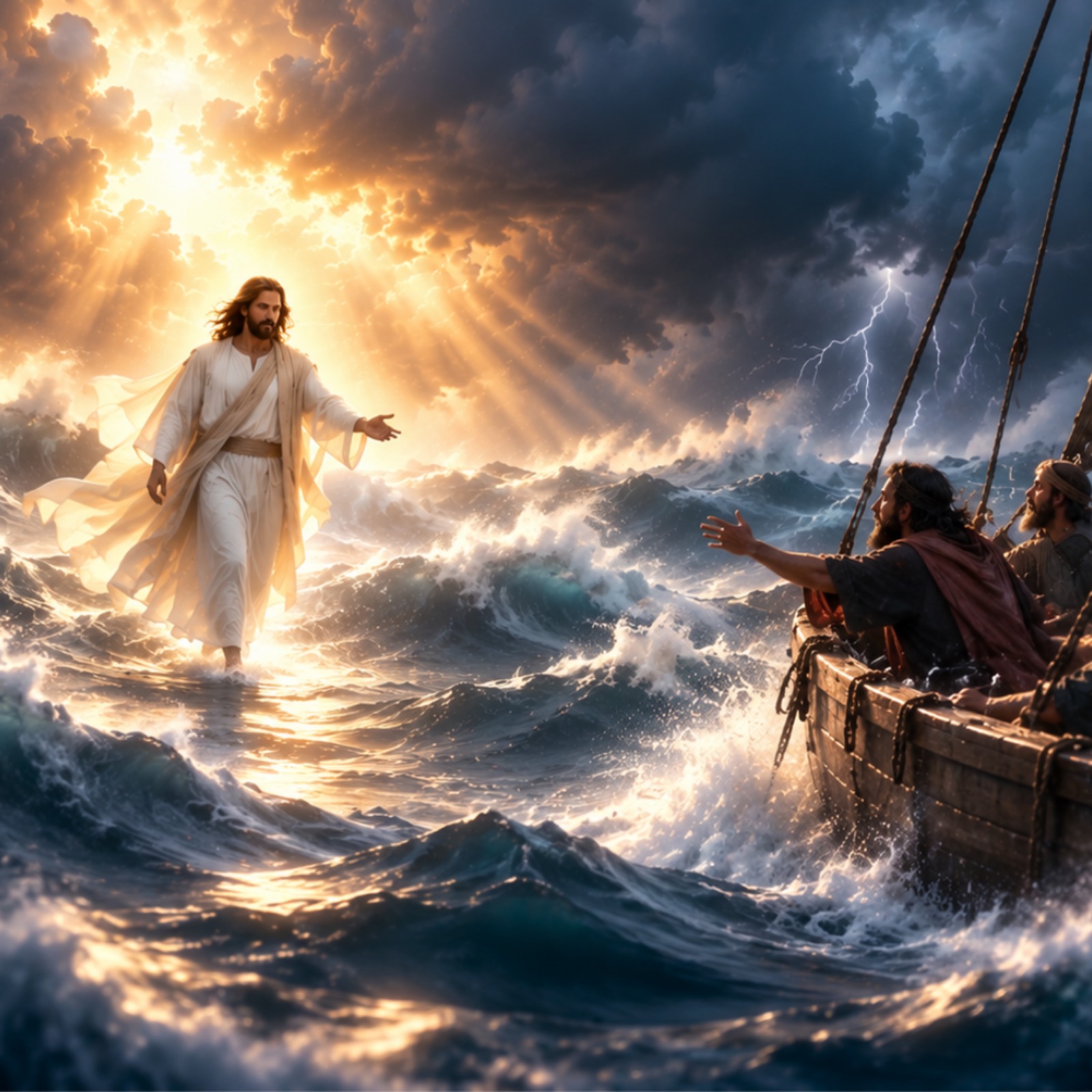
46:36 They didn't get it. And it has the same story in Mark chapter 8 and in Luke chapter 8. Yes, yes. And I love this one also, Mark chapter 6, 45 to 51. Immediately he made his disciples get into the boat and go before him to the other side, to Bethsaida, while he dismissed the crowd. And after he had taken leave of them, he went up to the mountain to pray. And when evening came, the boat was out on the sea. and he was alone on the way. And he saw that they were making headway painfully, for the wind was against them. And about the fourth watch of the night he came to them walking on the sea. He meant to pass by them, but when they saw him walking on the sea they thought it was a ghost, and cried out.
47:24 For they all saw him and were terrified. But immediately he spoke to them and said, Take heart, it is I, do not be afraid. And he got into the boat with them, and the wind ceased, and they were utterly astounded. And there was a saying we heard of the sailors that were lost on the ocean. On the Sea of Galilee. On the Sea of Galilee, that their spirits would be there. But it was a storm. And so this is what they're thinking when they think they're going to die. Yep, yep. They're coming to take them to... What is it? Davy Jones Locker. That was what the old sailors used to say, that if you were going to drown, that's where you were taken, to Davy Jones Locker.
48:16 I don't know who Davy Jones was, but anyway, he must have been an old sailor. Yeah, that was just a little bonus. Yeah, yeah. So this morning, I was waiting on the Lord. and asking him, what are you seeing? And I received this in my journal, because I feel like as we're looking at this idea of Jesus is Jehovah, and this idea of he calms the waters, he stills the sea, he began to speak to me out of this. And he said, What does tranquility look like? You are picturing a mirror -like tranquil mountain lake with no wind to disturb the waters. But what if I want you to see tranquility in the midst of turmoil?
49:14 What if I need you to walk in my deeply founded peace in the midst of the storm? What if the waves are crashing around you? Will you come and walk on the water with me? This is for you too. This isn't just for me. This is for all of us. You can have the immovable tranquility of the Mirror Mountain Lake at all times. The weight of my presence, this is so good, the weight of my presence will stop the storm within you when the storm is all around you. That's so good. I think I need to read that again so you don't have to rewind. The weight of my presence will stop the storm within you when the storm is all around you. While walking on the water to me, Peter became overwhelmed by the wind and waves and began to doubt and sink. While you are no better than Peter, you do have the advantage of the baptism in the Holy Spirit to give you the boldness that Peter later received. So he didn't have it at that moment. And that was part of what we were just reading. It was in a different, I think it was in the Matthew account where Peter is walking on the water. The disciples only grew bolder as the persecution increased. Meditate on this principle to prepare you for the next season. You must not draw back from conflict and stormy seas. I am within you and I still
50:48 calm storms. So this is just the beginning of this study. We're going to have a part two. We'll have that for the next episode. But I want you to focus on, you need to focus on this thought that Yehovah calms the storm. Our Father calms the storm. And Jesus calms the storm, but the most important storm to be calmed is the one inside of us. You know, sometimes we have a storm in a water glass, and, you know, it's the one that's inside. It's that anxiety. It's that depression. It's that the words that are coming from the accuser of the brethren that's causing us to have a storm in our water glass. When he wants us to walk in that tranquility, in Him of knowing who we are in Him, knowing who He is in us, having that peace that passes understanding. I mean, if everything all around us is not tranquil, we can still be tranquil because the fruit of the Holy Spirit is love and joy and peace and long -suffering. All those things that are contrary to our fleshly nature. We have to walk in the Spirit and not in the flesh. And this walking in the Spirit is what gives us the boldness to
52:22 step up regardless of what's going on around us. There can be raging seas all around us, and we must not give in to that situation. and our inner man. Our inner man must retain that tranquility, just sink down into the presence of the Lord, because it's His presence that, it's the weight of His glory, as I just read, it's the weight of His glory, it's the weight of His presence that calms our raging sea inside of us. So I just want to pray for you. Father, in the name of the Lord Jesus Christ, I pray for our listeners, our viewers, Lord, that each and every one of us will have a fresh endowment of your Spirit, a fresh outpouring in our lives that will bring us into a place of greater peace because you and the Father are one and you are doing today.
53:27 what it was prophesied in the Hebrew Scriptures that you did 2 ,000 years ago when you walked the earth, and you're still doing it in us, and you want to do it through us. So, Lord, all of these things that we've been studying, we ask you to work that in us by your Spirit, that your name will be glorified and your kingdom will be built, and that your outpouring of your Spirit will flow through us who love you. In Jesus' name, amen. Amen. Check out our website at globaloutpouring .org to find out more information, read our blogs, connect with us, and donate. You can also browse our web store for life -changing anointed books.
54:32 Until next time, this is Sharon Buss. And I'm Philip Buss. God bless you with His overwhelming, loving presence.


